
Role of FibroScan in Detecting Liver Fibrosis and Cirrhosis




On this page
The liver, a highly complex organ with digestive, endocrine, and immunological-regulatory functions, plays an important role in maintaining physiological homeostasis through metabolism, detoxification, and immune response. Viruses, alcohol, metabolites, toxins, and other pathogenic agents can all impair liver function, resulting in acute or chronic injury and the possibility of developing end-stage liver disease. While liver illnesses share basic characteristics, they have diverse pathophysiological, clinical, and therapeutic patterns. Currently, liver illnesses cause to nearly 2 million deaths globally each year, inflicting huge economic and social consequences.
Is Fibro Scan better than Liver Biopsy for the diagnosis of liver Fibrosis and Cirrhosis?
The best way to diagnose liver cirrhosis until recently was through biopsy, but this procedure is intrusive, expensive, and may have risks. Fibroscan is a novel non-invasive substitute that eliminates the need for a biopsy by evaluating liver stiffness and offering insight into cirrhosis and fibrosis. Fibroscan can quantify the amount of fat in the liver in addition to evaluating hepatic fibrosis. It also allows for the tracking of disease progression or regression, which helps physicians develop customised treatment regimens. In addition to being less expensive and non-invasive, it is also quicker and just as precise as a biopsy.
It is crucial to use modern diagnostic technologies like Fibroscan because early liver disease is asymptomatic and liver function tests have a limited capacity to identify fibrosis or cirrhosis. In order to stop liver disease from getting worse, early diagnosis enables prompt medical intervention, lifestyle changes, and focused treatment. Patients with liver illness can improve their quality of life and survival rates by using Fibroscan, a non-invasive, cost-effective, and efficient method of early diagnosis.
Now that Fibroscan is available, there is much less need for an expensive, invasive liver biopsy. Patients might enhance their chances of life by avoiding the serious consequences of liver disease with early diagnosis and individualised treatment.
What are the symptoms of liver disease?
The following symptoms may suggest liver illness or damage:
- Chronic tiredness and excessive sleepiness.
- jaundice, yellowing of the skin and eyes
- Ascites, swelling in the legs and ankles.
- Dark urine and pale faeces.
- Itchy skin.
- Loss of appetite
- unexplained weight loss
What is Liver Elastography or Fibroscan?
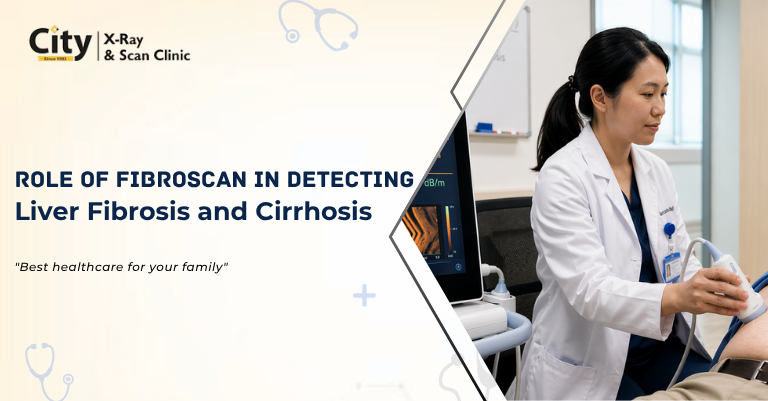
Fibroscan is a non-invasive imaging method that looks at the liver using ultrasonic technology. This scanning technique evaluates the condition of the liver and looks for fibrosis, which is the accumulation of extra fibrous tissue as a result of collagen tissue scarring. It is a cutting-edge ultrasound technology (transient elastography) used to evaluate liver health, identify liver stiffness, test for liver fibrosis (scarring), and determine the amount of fat stored in the liver (steatosis). This non-invasive test determines the risk of cirrhosis, liver fibrosis, and fatty liver disease in people who have hepatitis, obesity, hyperlipidemia, long-term alcohol consumption, or have specific symptoms like jaundice (yellowing of the skin and eyes) or abnormal liver function test results. FibroScan is a rapid, painless procedure that helps determine the risk of liver cancer and provides extremely accurate results without the need for a liver biopsy.
For a number of liver-related conditions, such as cirrhosis and hepatic tumours, doctors advise using the Fibroscan test. In these situations, a Fibroscan can identify any indications of acute liver failure and declining liver function. The test is also used to evaluate aberrant liver fat accumulation, which is frequently linked to non-alcoholic fatty liver disease (NAFLD).
This rapid, painless, non-invasive test provides accurate information on liver function and supports medical management, making it a safer option than a biopsy.
Why Is a Fibroscan Necessary?
If you exhibit any indications of increasing liver illness, doctors advise a Fibroscan liver test since it provides more sensitive and specific results than a conventional ultrasound scan for fibrosis detection. The test enables prompt medical intervention and efficient treatment planning by detecting liver problems early.
Who should consider getting a FibroScan?
FibroScan is appropriate for persons at risk of liver disease or those engaging in habits that may affect the liver, including the following:
- People who are overweight, obese, or suffer from fatty liver disease.
- Individuals with diabetes, hypertension, or hyperlipidemia
- People with abnormal liver function or chronic hepatitis
- Individuals having a family history of cirrhosis
- Individuals with hepatitis B and C, or those at risk of hepatitis
- Individuals who frequently consume alcohol (liquor, beer, etc.) or have alcoholic liver disease.
- Individuals with abnormal liver function tests, such as increased ALT and AST liver enzyme levels
- Individuals with abnormal liver radiology findings, such as ultrasounds or CT scans
Preparing for Fibroscan
- For 2 hours before to the FibroScan, refrain from eating or drinking.
- Avoid consuming alcohol for at least 48 hours before the exam.
- You can continue to take your regular prescriptions as before. Sips of water are permitted.
Fibroscan Procedure
- The medical staff will place the patient supine with both arms raised above the head, tilting the head and feet to the left to enlarge the area above the right rib cage.
- The doctor will place the FibroScan transducer, with its tip coated in cooling gel, on the right rib cage, immediately above the liver, and emit low-frequency sound waves through the skin into the liver tissue. The patient will feel a mild vibration but will not experience pain.
- The FibroScan instrument uses the speed of reflected sound waves (VCTE) to calculate liver stiffness in kilopascals (kPa). If there is scar tissue in the liver, sound waves reflect fast, giving a high kPa reading.
- Simultaneously, the FibroScan assesses the liver's resistance (CAP) in decibels per meter. If the liver has an excessive quantity of fat, it will exhibit significant resistance, leading in a high dB/m reading score.
- The doctor will perform the treatment at the same area about ten times. The exam lasts about 5-10 minutes, and the results are available immediately. The doctor will use the data to diagnose the illness or disease and prescribe specific treatment.
What should you do if the FibroScan test results show fibrosis or steatosis?
If the FibroScan results indicate fibrosis or steatosis, the doctor will detail the treatment approach and provide the following instructions:
- Treat the underlying cause and any associated illnesses, such as fatty liver, excessive cholesterol, hepatitis, alcoholic liver disease, or diabetes. Take your meds as directed.
- Alcohol should be avoided entirely by persons with fibrosis because it can promote fibrosis production.
- Control your diet and weight by avoiding or limiting high-fat foods such as fried foods, fatty foods, and sweets, as well as refined carbs. Instead, boost your consumption of veggies, fruits, and lean proteins.
- Exercise at least 3-5 times a week for a total of 150 minutes, using activities such as brisk walking, jogging, swimming, or cycling. Lose weight gradually and set specific targets, such as losing 5-10% of your body weight.
- Monitor your condition on a frequent basis with your doctor. Attend all planned blood tests, ultrasound exams, or FibroScans to assess whether the fibrosis has improved or worsened, as well as the quantity of fatty liver that has decreased.
Can fibrosis and steatosis be reversed?
Fatty liver disease can be improved by losing weight. Early-stage fibrosis or scarring can be cured if detected early, and the underlying cause is properly treated, such as receiving antiviral medication for hepatitis patients or making significant lifestyle changes, such as losing weight, controlling diet, fat, and sweets intake, and maintaining a disciplined exercise routine, including reducing or quitting alcohol consumption for fibrosis patients.
Moderate and severe fibrosis can be improved or partially reversed if the underlying cause is recognized and treated early, allowing the liver to heal itself. End-stage liver fibrosis is incurable, but with adequate therapy, advancement can be delayed and effects minimized. Finally, whether a cure is possible is decided by the disease's source and stage at the time of identification, as well as the speed with which it is treated initially.
Conclusion
The FibroScan is a portable instrument that measures liver elasticity as a sign of fibrosis. The probe, which includes an ultrasonic transducer and a vibrator, is implanted in the intercostal space above the right lobe of the liver. A vibration is given to the tissue, resulting in a wave that travels through the liver. The ultrasound detects this wave and calculates its velocity, which is indicative of tissue stiffness.
Frequently Asked Questions
How does FibroScan operate and what is it?
FibroScan is a non-invasive diagnostic that uses transient elastography to gauge liver stiffness. It computes the speed at which painless vibrations enter the liver. A stiffer liver, typically linked to cirrhosis or fibrosis, is indicated by a faster wave speed.
Is liver fibrosis accurately detected by FibroScan?
Indeed, FibroScan is very good at identifying liver fibrosis, particularly when it's in intermediate to advanced stages. It aids in the classification of fibrosis into stages (F0–F4), enabling medical professionals to evaluate its severity and choose the best course of action.
Can cirrhosis be accurately diagnosed using FibroScan?
When it comes to identifying cirrhosis (F4 stage), FibroScan is incredibly accurate. Cirrhosis is strongly indicated by high liver stiffness scores, while further testing may occasionally be necessary to confirm the diagnosis.
Can early liver disease be detected using FibroScan?
Indeed, FibroScan can identify fibrosis in its early stages before symptoms manifest, enabling prompt intervention and lifestyle modifications to stop the disease's progression.
What occurs if high stiffness values are displayed by FibroScan?
Significant cirrhosis or fibrosis may be indicated by high liver stiffness readings. Based on the results, your doctor might suggest additional testing, lifestyle modifications, or therapy.
Is it safe to use FibroScan repeatedly?
Indeed, FibroScan is safe and radiation-free, making it appropriate for long-term, recurring monitoring.
Can FibroScan take the place of routine liver examinations?
FibroScan is a valuable diagnostic tool, but for a thorough liver examination, it should be used in conjunction with blood tests, imaging, and clinical evaluation.
Do I need to prepare before having a FibroScan?
Yes, basic preparation is necessary. Patients are typically recommended to fast for 2-3 hours prior to the test and avoid alcohol for at least 24 hours to guarantee proper findings.
Are there any things that can alter FibroScan results?
Certain factors, such as recent meal intake, liver inflammation, obesity, or poor probe selection, might all have an impact on the results. In obese patients, an XL probe is frequently utilised to improve accuracy.
How often should FibroScan be performed for monitoring?
FibroScan is usually indicated once every 6-12 months for patients with chronic liver disease. The frequency may vary according to the severity of the disease and the response to treatment.



Comments List