
Complete Blood Count (CBC) Test: Normal Range, Report Explained and What Abnormal Results Mean

- What is a CBC test?
- Why do doctors advise a CBC?
- What does a CBC report include?
- Understanding each part of the CBC
- Common patterns and what they may suggest
- How to prepare for a CBC test
- How the test is done
- What can affect your CBC result?
- When to see a doctor
- How often should you do a CBC?
- CBC testing at City X-Ray & Scan Clinic
- Blood Test in Delhi: Blood Test Near Me with Free Home Sample Collection
- Related tests and articles
- Key takeaways
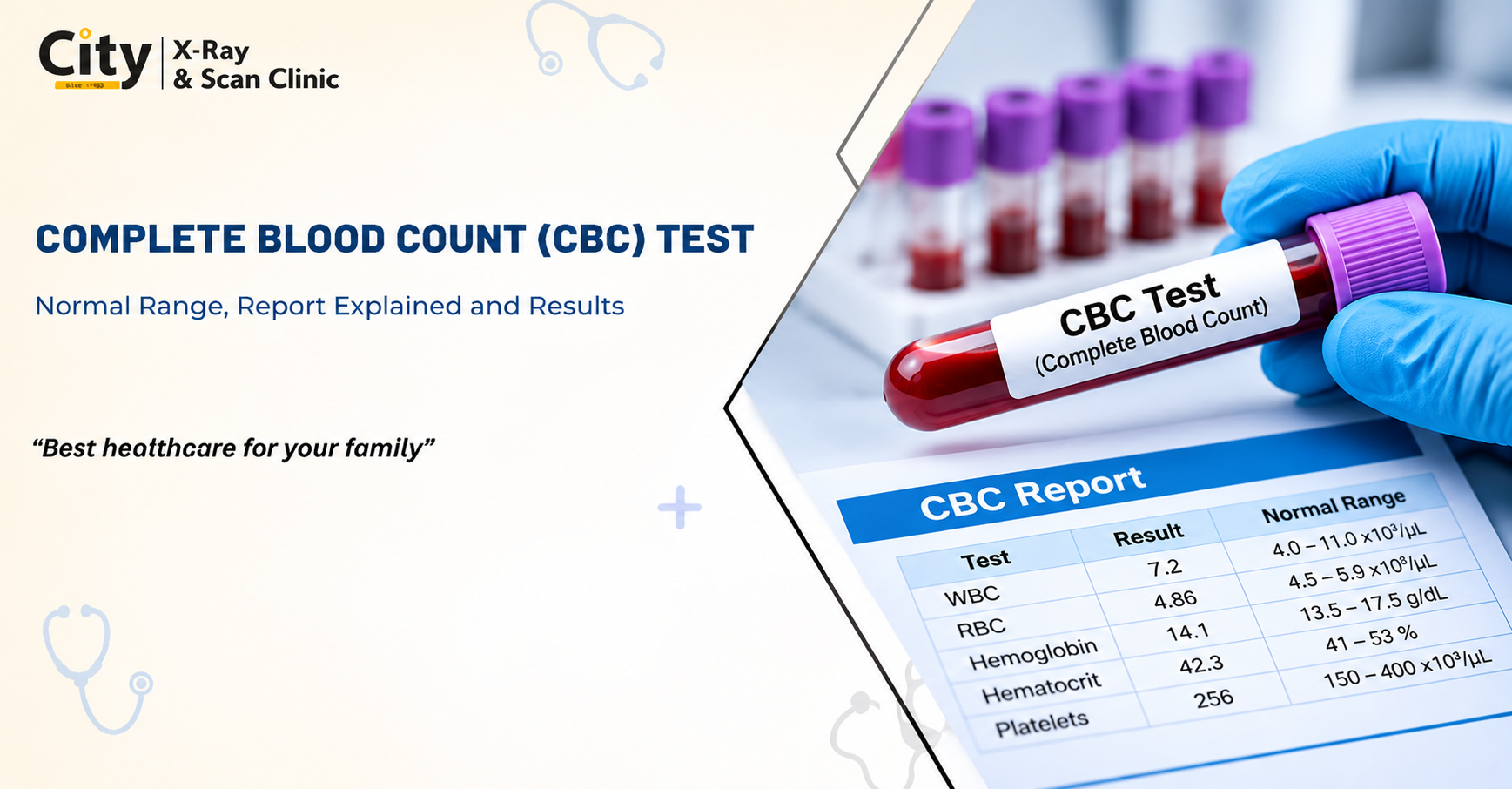
A complete blood count (CBC) is a common blood test that measures your red blood cells, white blood cells, haemoglobin, haematocrit (PCV) and platelets. It helps check for anaemia, infection, inflammation, clotting problems and many other conditions. No special preparation is usually needed, and the result is mostly available within hours. Always compare your values with the reference range printed on your own report, since ranges differ slightly between laboratories.
What is a CBC test?
CBC stands for complete blood count. It is one of the most commonly advised blood tests in the world. A small sample of blood is taken from a vein in your arm, and an automated analyser counts and measures the cells in it. People often search for it as "complete blood test," "blood count test" or "CBC blood test."
Blood contains three main types of cells:
- Red blood cells (RBCs) carry oxygen from the lungs to the body. They contain haemoglobin.
- White blood cells (WBCs) are part of the immune system and fight infection and inflammation.
- Platelets help blood to clot and stop bleeding.
A CBC gives information about all three, and it is often the first test used to look for general health problems.
Why do doctors advise a CBC?
A CBC may be advised:
- as part of a routine health check-up
- to look for anaemia (low haemoglobin) in tiredness, pallor, breathlessness or hair loss
- to check for infection in fever or unexplained illness
- to evaluate bleeding or easy bruising
- to monitor chronic conditions and treatment, such as chemotherapy or some medicines
- before surgery or procedures
- in pregnancy, to check for anaemia
- to diagnose or follow blood disorders
- in fever with low platelets, as in dengue, where regular counts help to guide care
What does a CBC report include?
A standard CBC report lists:
| Parameter | What it measures | Approximate adult reference range* |
|---|---|---|
| Haemoglobin (Hb) | Oxygen-carrying protein in red cells | Men: about 13 to 17 g/dL; Women: about 12 to 15 g/dL |
| RBC count | Number of red blood cells | Men: about 4.5 to 5.9 million/µL; Women: about 4.1 to 5.1 million/µL |
| PCV/Haematocrit | Percentage of blood made up of red cells | Men: about 40 to 52%; Women: about 36 to 46% |
| MCV | Average size of a red cell | About 80 to 100 fL |
| MCH | Average haemoglobin in each red cell | About 27 to 33 pg |
| MCHC | Haemoglobin concentration in red cells | About 32 to 36 g/dL |
| RDW | Variation in red cell size | About 11.5 to 14.5% |
| Total WBC count | Number of white blood cells | About 4,000 to 11,000 per µL |
| Platelet count | Number of platelets | About 1.5 to 4.5 lakh per µL (150,000 to 450,000) |
| MPV | Average platelet size | About 7.5 to 11.5 fL |
| Differential count | Types of white cells (neutrophils, lymphocytes, monocytes, eosinophils, basophils) | Varies by cell type |
*Reference ranges differ with the laboratory, equipment, age, sex, pregnancy and altitude. Always use the range printed on your own report. These figures are for general understanding only.
Understanding each part of the CBC
Haemoglobin (Hb)
Haemoglobin carries oxygen. Low haemoglobin means anaemia. Common causes include iron deficiency, vitamin B12 or folate deficiency, blood loss, chronic disease, and some inherited conditions. Symptoms include tiredness, pale skin, breathlessness, dizziness, palpitations and headaches. High haemoglobin may occur with dehydration, smoking, living at high altitude, lung disease, or rarely a bone marrow condition.
RBC count and PCV
These support the haemoglobin result. A low RBC count and PCV suggest anaemia, while high values may indicate dehydration or polycythaemia.
MCV, MCH, MCHC and RDW
These are called red cell indices and help to find the type of anaemia. For example, a low MCV with low MCH often points to iron deficiency or thalassaemia trait, while a high MCV may point to vitamin B12 or folate deficiency. A high RDW suggests red cells of mixed sizes. (See our separate guide on red cell indices for more detail.)
Total WBC count
High WBC count (leucocytosis): often seen in bacterial infection, inflammation, stress, smoking, steroid use, and in some blood disorders.
Low WBC count (leukopenia): may occur in some viral infections, certain medicines, bone marrow problems, autoimmune conditions and nutritional deficiencies.
Differential count
This shows the proportion of each white cell type:
- Neutrophils: usually rise in bacterial infection.
- Lymphocytes: often rise in viral infections.
- Eosinophils: may rise in allergy, asthma and parasitic infection.
- Monocytes: may rise in some chronic infections and inflammation.
- Basophils: rarely significant, may rise in some blood disorders.
Platelet count
Low platelets (thrombocytopenia) may happen in dengue and other viral infections, certain medicines, immune conditions, liver disease, and bone marrow problems. Very low counts raise the risk of bleeding.
High platelets (thrombocytosis) may occur after infection or surgery, with iron deficiency, inflammation, or rarely a bone marrow disorder.
MPV
MPV tells the average size of platelets. It is interpreted along with the platelet count and is helpful in some conditions that affect platelet production or destruction.
Common patterns and what they may suggest
| Pattern on CBC | May suggest | What the doctor may check next |
|---|---|---|
| Low Hb, low MCV, high RDW | Iron deficiency | Serum ferritin, iron studies |
| Low Hb, high MCV | Vitamin B12 or folate deficiency | Vitamin B12, folate |
| Low Hb, low MCV, normal or high RBC count | Thalassaemia trait | Haemoglobin electrophoresis (HPLC) |
| High WBC with high neutrophils | Bacterial infection or inflammation | Clinical examination, CRP, cultures |
| High lymphocytes | Viral infection or other causes | Further tests as needed |
| Low platelets with fever | Dengue or other infections | Repeat counts, dengue tests |
| High eosinophils | Allergy, asthma or parasitic infection | Allergy evaluation, stool tests |
These patterns are only clues. Diagnosis needs your symptoms, examination and often more tests.
How to prepare for a CBC test
- Fasting is not required for a CBC alone. If other tests are ordered with it, such as fasting sugar or lipid profile, you may need to fast.
- Drink water as usual unless told otherwise.
- Tell the lab about medicines you take, recent illness, blood transfusion, or pregnancy.
- Wear a top with sleeves that can be rolled up easily.
How the test is done
A trained phlebotomist cleans the skin, ties a band on the upper arm and inserts a thin needle into a vein to collect a few millilitres of blood into a tube that contains an anticoagulant. You may feel a brief pinch. The sample is then tested in an automated analyser. If the machine flags unusual cells, a technician or pathologist may examine a blood smear under the microscope. Results are often ready the same day.
What can affect your CBC result?
- Dehydration can raise haemoglobin and PCV.
- Pregnancy lowers haemoglobin and PCV because of increased blood volume.
- Altitude and smoking can raise haemoglobin.
- Recent exercise, stress or illness can raise WBC count.
- Medicines, such as steroids, antibiotics and chemotherapy, can change counts.
- Time of day and posture can slightly alter values.
- Sample problems, such as clotting in the tube or delayed testing, may give false values.
If a result is slightly outside the range but you feel well, your doctor may simply repeat the test.
When to see a doctor
Speak to a doctor soon if your CBC is abnormal, and seek urgent care if you also have:
- severe weakness, breathlessness or chest pain
- fever with very low platelet counts, bleeding from the nose, gums or in stools, or black stools
- unexplained weight loss, night sweats or lumps
- persistent fever or repeated infections
- yellow eyes or skin
How often should you do a CBC?
There is no single schedule for everyone. Many adults include a CBC in an annual or periodic health check-up, and your doctor may advise it more frequently if you have a chronic illness, are pregnant, take certain medicines or are being treated for a blood disorder.
CBC testing at City X-Ray & Scan Clinic
City X-Ray & Scan Clinic offers CBC and other pathology tests through its laboratory services in Delhi. Reports are verified by qualified pathology staff.
Blood Test in Delhi: Blood Test Near Me with Free Home Sample Collection
If you are searching for a blood test near me or a blood test in Delhi, City X-Ray & Scan Clinic offers a wide menu of pathology tests with accurate and timely reports. City X-Ray & Scan Clinic is a NABH accredited (radiology) and NABL accredited (pathology) diagnostic centre, as per scope, with more than 32 years of experience in diagnostic healthcare in Delhi. You can find us at City X-Ray centres in Tilak Nagar, Vikaspuri and Vishnu Garden, and at City Imaging partner labs across West and South Delhi, including Dwarka (Sector 6 and Sector 12A), Janakpuri, Paschim Vihar, Hari Nagar, Najafgarh, Naraina, Palam, Sagarpur and Safdarjung Development Area (SDA). See the full list on our Locate Us page.
You can book a blood test at home with free home sample collection, or visit a centre. Ask about the CBC test price in Delhi, LFT test price in Delhi and our health check-up packages. Useful links:
- Best pathology lab in Delhi
- Free home blood sample collection
- CBC (complete blood count) test
- Liver function test (LFT)
- Health check-up packages
To book, call 011-4725-2000, send "Hi" on WhatsApp to 9577727772, or book online at www.cityxrayclinic.com. Timings differ by centre (most open from 7:00 AM or 8:00 AM, and some stay open until 11:00 PM), and free home sample collection is available for blood tests. Please check the Locate Us page or call before you visit to confirm that the scan you need is available at your nearest centre.
Related tests and articles
Depending on your CBC result, your doctor may also advise related tests. You can book them online:
- CBC with ESR and ESR test to check inflammation
- Haemoglobin (Hb) test and platelet count for anaemia and bleeding concerns
- Ferritin test and iron profile for iron deficiency
- Vitamin B12 test for B12 deficiency anaemia
- Thyroid profile to check thyroid function
Also read: CRP Test: Normal Range, Price, Procedure, Uses and What High CRP Levels Mean and Thyroid Problems: Symptoms, TSH Test, Normal Range and When to Get Tested.
Key takeaways
- A CBC measures red cells, white cells, haemoglobin and platelets, and gives a broad picture of health.
- It helps to find anaemia, infection, inflammation and clotting problems.
- No fasting is needed for a CBC alone.
- Use the reference range on your own report, and discuss abnormal values with your doctor.
- One abnormal value does not mean disease. Doctors consider the whole picture.










Comments List