
CRP Test: Normal Range, Price, Procedure, Uses, and What High CRP Levels Mean

- Key Takeaways
- What Is a CRP Test?
- Why Is a CRP Test Done?
- CRP Test Normal Range
- What Does a High CRP Level Mean?
- What Does a Low or Normal CRP Level Mean?
- Types of CRP Tests
- How Is the CRP Test Performed?
- Is Fasting Required for a CRP Test?
- CRP Test Price in Delhi
- CRP Test vs ESR Test: What Is the Difference?
- CRP Test and Other Related Diagnostic Tests
- How to Prepare for a CRP Test
- When Should You Consult a Doctor About High CRP?
- Frequently Asked Questions About the CRP Test
- Conclusion
- Related Articles
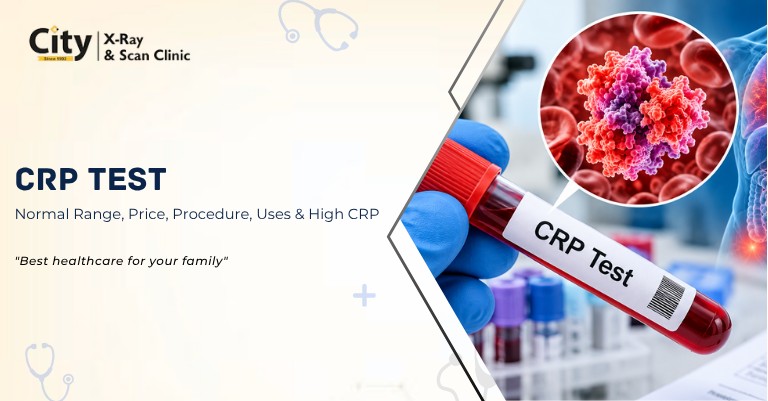
The CRP test (C-reactive protein test) is a blood test that measures the level of C-reactive protein in the blood to help identify inflammation in the body. CRP levels may increase due to infections, autoimmune disorders, tissue injury, and other inflammatory conditions. Doctors may recommend this test to assess inflammation, monitor treatment response, and evaluate certain medical conditions alongside symptoms, physical examination, and other diagnostic tests.
If you are looking for a CRP test in Delhi, understanding its purpose, normal range, procedure, and interpretation can help you prepare for your diagnostic appointment.
Key Takeaways
- CRP is a protein made by the liver that rises when there is inflammation in the body.
- Many labs use a normal range of below about 5 mg/L; always follow the range printed on your report.
- A high CRP shows inflammation, not the exact cause.
- Fasting is usually not required.
- At City X-Ray & Scan Clinic, the quantitative CRP test is about INR 412 and the hs-CRP test about INR 850.
What Is a CRP Test?
The C-reactive protein (CRP) test is a laboratory investigation that measures the concentration of CRP, a protein produced primarily by the liver in response to inflammation. Its production increases when the body experiences an inflammatory response, often triggered by infection, injury, or certain chronic diseases.
The CRP test is commonly used in clinical practice because it provides a useful indication of inflammation. However, it does not identify the exact cause or location of inflammation on its own.
Doctors may recommend a CRP blood test when a patient has symptoms such as fever, unexplained body aches, swelling, or suspected infection. It may also be used to monitor inflammatory conditions and evaluate whether treatment is helping.
Why Is a CRP Test Done?
A doctor may recommend a CRP test for several reasons, depending on the patient's symptoms and medical history:
- To help assess infections: CRP levels can rise during bacterial and some viral infections.
- To evaluate inflammation: The test may help identify an inflammatory response associated with various medical conditions.
- To monitor treatment: Changes in CRP levels can help doctors assess the response to treatment in selected conditions.
- To monitor autoimmune diseases: Conditions such as rheumatoid arthritis may cause elevated CRP levels.
- To assess tissue injury: Surgery, trauma, and other forms of tissue damage can increase CRP.
- To support clinical evaluation: CRP results may be interpreted alongside other blood tests, imaging studies, and clinical findings.
Note: A CRP result should not be used alone to diagnose an infection or determine whether antibiotics are required.
CRP Test Normal Range
The normal CRP range can vary depending on the laboratory, testing method, and units used. Many laboratories consider a CRP level below approximately 5 mg/L to be within the reference range, although the range printed on the laboratory report should always be used for interpretation.
| CRP Level | General Interpretation |
|---|---|
| Below 5 mg/L | Often within the normal reference range |
| 5–10 mg/L | May represent a mild elevation, depending on the laboratory |
| 10–100 mg/L | Elevated; may occur with infection or other inflammatory conditions |
| Above 100 mg/L | Markedly elevated; can occur in significant infections or severe inflammation |
These ranges are approximate, not universal diagnostic cut-offs. A CRP value must be interpreted in the context of symptoms, examination findings, other investigations, and the laboratory's reference interval. Even a normal result does not completely exclude an early infection or a condition causing inflammation.
What Does a High CRP Level Mean?
A high CRP level means that an inflammatory response may be occurring in the body. It does not automatically mean that a person has a bacterial infection or a serious disease.
Common causes of elevated CRP include:
- Bacterial and viral infections (such as viral fever, dengue or typhoid)
- Pneumonia and other respiratory infections
- Urinary tract infections
- Rheumatoid arthritis and other inflammatory disorders
- Inflammatory bowel diseases
- Physical injury, burns, or recent surgery
- Some chronic inflammatory conditions
- Obesity and smoking, which may be associated with low-grade inflammation
Very high CRP levels can occur in serious infections, including sepsis, but the diagnosis requires urgent clinical assessment and other investigations. A doctor may recommend additional tests to identify the underlying cause.
What Does a Low or Normal CRP Level Mean?
A low or normal CRP result generally indicates that there is no substantial systemic inflammatory response detectable at the time of testing. However, it does not rule out every infection or inflammatory disease.
CRP may remain low during the early stages of an illness, and some conditions cause only a limited increase. If symptoms persist despite a normal result, a doctor may recommend repeat testing or additional investigations based on the clinical findings.
Types of CRP Tests
There are two commonly discussed forms of CRP testing:
- Standard CRP Test: Measures C-reactive protein and is primarily used to help assess inflammation associated with infections, tissue injury, and inflammatory diseases. It may also be used to monitor disease activity or treatment response. See the CRP Quantitative test.
- High-Sensitivity CRP (hs-CRP) Test: Measures lower concentrations of CRP more precisely. It may be used as one component of cardiovascular risk assessment in appropriate patients. See the hs-CRP test.
The hs-CRP test is not the same as a routine CRP test for suspected acute infection. Cardiovascular risk assessment requires consideration of cholesterol levels (a lipid profile is often checked), blood pressure, diabetes, smoking, medical history, and other relevant risk factors.
How Is the CRP Test Performed?
The CRP test is a simple blood investigation performed in a pathology laboratory. The procedure generally involves the following steps:
Step 1: Patient identification
The laboratory confirms the patient's details and test request.
Step 2: Blood sample collection
A trained phlebotomist cleans the collection site and draws blood from a vein, usually in the arm.
Step 3: Sample processing
The blood sample is handled and processed according to the laboratory's testing protocol.
Step 4: Laboratory analysis
An appropriate laboratory analyzer measures the CRP concentration.
Step 5: Report generation
The result is reported with the relevant units and laboratory reference range for clinical interpretation.
The procedure usually takes only a few minutes. Some people may experience brief discomfort or minor bruising at the blood collection site. Free home sample collection may also be available.
Is Fasting Required for a CRP Test?
Fasting is generally not required for a standard CRP test. Patients can usually eat and drink normally unless their doctor has ordered additional tests that require fasting.
If the CRP test is being performed alongside investigations such as a fasting blood glucose test or lipid profile, the laboratory may provide specific preparation instructions. Always follow the instructions given by your healthcare provider or diagnostic laboratory.
CRP Test Price in Delhi
The CRP test price in Delhi varies depending on the diagnostic centre, laboratory facilities, testing method, and whether the test is included in a health package.
- At City X-Ray & Scan Clinic: The standard quantitative CRP Test is priced at approximately ₹412, while the hs-CRP (High-Sensitivity CRP) test is priced around ₹850. Patients can also contact the centre directly to confirm any active health packages or promotional discounts.
When choosing a pathology laboratory, consider factors such as quality standards, sample-handling procedures, reporting reliability, and the availability of professional support for understanding your report.
CRP Test vs ESR Test: What Is the Difference?
Both CRP and ESR (erythrocyte sedimentation rate) are blood tests used to assess inflammation, but they measure different things.
| Feature | CRP Test | ESR Test |
|---|---|---|
| Full form | C-reactive protein | Erythrocyte sedimentation rate |
| What it measures | CRP concentration in blood | Rate at which red blood cells settle in a tube |
| Response to inflammation | Often rises and falls relatively quickly | May change more slowly |
| Common uses | Assessing inflammation and monitoring selected infections or inflammatory conditions | Assessing and monitoring selected inflammatory conditions |
| Interpretation | Affected by infection, injury, and other inflammatory processes | Also affected by factors such as age, anaemia, and pregnancy |
Doctors may order both tests when additional information about an inflammatory condition is useful. Neither test identifies the underlying cause by itself.
CRP Test and Other Related Diagnostic Tests
A CRP test is often interpreted alongside other pathology and radiology investigations to help doctors determine the cause of inflammation.
Related Pathology Tests
- CBC Test (Complete Blood Count): Evaluates blood cells and may help identify changes associated with infection, anaemia, or other conditions. See the CBC test.
- ESR Test: Measures the erythrocyte sedimentation rate and provides additional information about inflammation.
- Procalcitonin Test: May help assess suspected bacterial infection and sepsis in appropriate clinical settings.
- Blood Culture Test: Helps identify microorganisms in the bloodstream when a bloodstream infection is suspected.
- Urine Culture Test: Helps identify bacteria or other organisms responsible for a urinary tract infection. See Urine Culture & Sensitivity.
- Liver Function Test (LFT): Evaluates markers of liver function and injury, including liver enzymes. See the LFT package.
- Kidney Function Test (KFT): Assesses kidney-related markers such as creatinine and urea. See the KFT test.
- Rheumatoid Factor (RF) Test: May support the evaluation of rheumatoid arthritis when interpreted with symptoms and other findings. See the RA Factor Quantitative test.
- Anti-CCP Test: Helps support the diagnosis of rheumatoid arthritis. See the Anti-CCP test.
- HbA1c Test: Measures average blood glucose over approximately two to three months and may be relevant when assessing overall metabolic health. See the HbA1c test.
Related Radiology Tests
Radiology investigations may be recommended when symptoms, examination findings, or laboratory results suggest a condition that requires imaging:
- Chest X-Ray: May help evaluate suspected pneumonia and certain other lung conditions. See Chest X-Ray PA and our digital X-ray facility.
- CT Scan of the Chest: Provides detailed cross-sectional images of the chest when a more detailed evaluation is indicated. See NCCT Chest.
- Ultrasound Whole Abdomen: Helps assess abdominal organs and may be recommended when abdominal pain or suspected abdominal disease requires investigation. See USG Whole Abdomen.
- CT Scan of the Abdomen: Provides detailed images of abdominal structures and may help evaluate selected infections, inflammatory conditions, or complications. See our CT scan facility.
- MRI Scan: Offers detailed images of soft tissues, joints, the spine, and other structures when clinically indicated. See our MRI scan facility.
- MRI Brain: May be recommended when neurological symptoms require detailed assessment of the brain. See MRI Brain.
- Ultrasound of the Pelvis: Helps evaluate pelvic organs when symptoms suggest a relevant gynaecological or urological condition. See USG Pelvis.
A high CRP level alone does not determine which imaging test is required. The doctor selects the appropriate investigation based on the suspected source of inflammation and the patient's clinical condition.
How to Prepare for a CRP Test
Most patients do not need extensive preparation before a CRP blood test. However, a few simple precautions can help ensure appropriate testing and interpretation:
- Follow any specific instructions provided by the laboratory.
- Inform your doctor about medicines and supplements you take.
- Mention any recent infection, surgery, injury, or ongoing inflammatory condition.
- Tell your healthcare provider if you have had similar tests recently, so changes in CRP can be assessed when appropriate.
- If other blood tests are being performed at the same appointment, confirm whether any of them require fasting.
Important: Do not stop prescribed medicines solely to influence your CRP result unless your treating doctor instructs you to do so.
When Should You Consult a Doctor About High CRP?
Consult a healthcare professional if your CRP result is elevated, particularly if you have persistent fever, unexplained pain, swelling, or other symptoms.
Seek urgent medical assessment if you experience warning signs such as difficulty breathing, confusion, severe weakness, fainting, or rapidly worsening illness. These symptoms require clinical assessment regardless of the CRP value.
Your doctor may recommend a repeat CRP test, a CBC, ESR, blood cultures, or other investigations depending on your symptoms. Imaging such as a chest X-ray, ultrasound, CT scan, or MRI may be considered if there is a specific clinical reason. Do not interpret CRP results in isolation or start antibiotics without appropriate medical advice.
Frequently Asked Questions About the CRP Test
1. What is the normal range of the CRP test?
Many laboratories use a reference range below approximately 5 mg/L for standard CRP testing. However, the exact range depends on the laboratory and testing method. Always check the reference interval on your report.
2. What does a CRP level of 10 mg/L mean?
A CRP level of 10 mg/L may indicate an elevation in inflammation, depending on the laboratory's reference range. Possible causes include infection, injury, and inflammatory disease. The result should be interpreted alongside symptoms and other investigations.
3. Is a CRP test used to detect infection?
Yes. The CRP test can help assess the inflammatory response associated with infection. However, it cannot independently confirm an infection, identify the responsible microorganism, or determine whether antibiotics are needed.
4. Can a CRP test detect cancer?
CRP is not a cancer-specific test and cannot diagnose or rule out cancer. Some cancers may be associated with elevated CRP, but many other conditions can also increase it. Appropriate investigations depend on the patient's symptoms and clinical assessment.
5. Is fasting required before a CRP test?
Fasting is generally not required for a standard CRP test. If other blood investigations are ordered at the same time, follow the laboratory's preparation instructions.
6. How long does it take to get a CRP test report?
Report turnaround time varies by laboratory, test availability, and processing requirements. Contact your diagnostic centre to confirm the expected reporting time before visiting.
7. What is the difference between CRP and hs-CRP?
Standard CRP testing is commonly used to assess inflammation, including that associated with infections and inflammatory diseases. The hs-CRP test measures lower CRP concentrations more precisely and may be used in cardiovascular risk assessment for selected patients.
8. Can CRP levels return to normal?
Yes. CRP levels can decrease as inflammation resolves or a condition responds to treatment. The rate of change depends on the underlying cause, its severity, and the patient's clinical course.
9. Which tests are done along with CRP?
Depending on the suspected condition, doctors may recommend a CBC, ESR, procalcitonin, blood culture, urine culture, or other blood tests. Radiology investigations may also be advised when imaging is needed to evaluate the suspected source of inflammation.
10. Where can I get a CRP test in Delhi?
You can contact City X-Ray & Scan Clinic to enquire about CRP testing, current pricing, sample collection arrangements, and report availability.
Conclusion
The CRP test is a useful blood investigation for assessing inflammation and monitoring selected infections and inflammatory conditions. Its results can help doctors understand the body's inflammatory response, but they do not identify the cause on their own.
For accurate interpretation, CRP levels should be evaluated alongside the patient's symptoms, medical history, physical examination, and other relevant pathology or radiology investigations. If your doctor has recommended a CRP test, follow the laboratory's instructions and discuss your results with a qualified healthcare professional.
Related Articles








Comments List