
CT Coronary Angiography: What Is It, Why Is It Done and What Does It Detect?

- Key Takeaways
- What Is CT Coronary Angiography?
- Why Is CT Coronary Angiography Done?
- What Does CT Coronary Angiography Detect?
- How Is CT Coronary Angiography Performed?
- How Long Does CT Coronary Angiography Take?
- Is CT Coronary Angiography Painful?
- How Should You Prepare for CT Coronary Angiography?
- Is Contrast Dye Used in CT Coronary Angiography?
- Are There Any Risks?
- CT Coronary Angiography vs Conventional Coronary Angiography
- Who Should Consider CT Coronary Angiography?
- When Should You Talk to a Doctor About Chest Pain?
- Finding CT Coronary Angiography Near Me
- Frequently Asked Questions
- Conclusion
- Related Articles
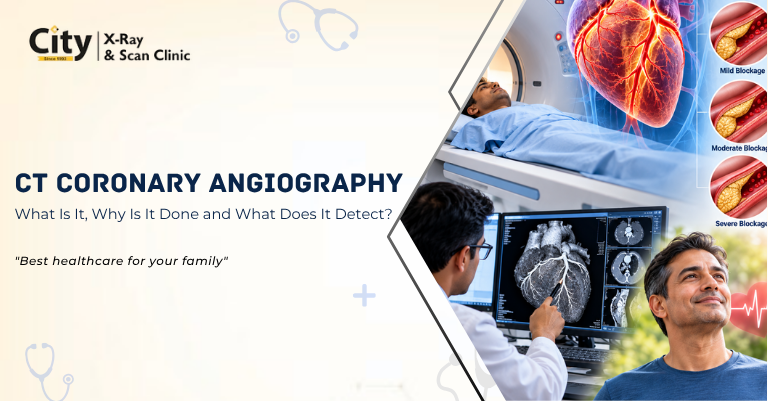
CT Coronary Angiography (CTCA) is a non-invasive imaging test that uses computed tomography (CT) and contrast dye to create detailed images of the coronary arteries—the blood vessels that supply oxygen-rich blood to the heart. It is commonly used to look for narrowing or blockages in the coronary arteries and to help doctors assess the risk of coronary artery disease.
If your doctor has recommended CT Coronary Angiography because of chest discomfort, suspected coronary artery disease, or other heart-related concerns, understanding the test can help you prepare with confidence.
For people searching for CT Coronary Angiography in Delhi, City X-Ray & Scan Clinic provides diagnostic imaging services with appointment-based testing.
Key Takeaways
- CTCA is a CT scan of the heart's arteries done through a vein in the arm, without a catheter in the artery.
- It can show narrowing, plaque, calcium and unusual artery anatomy.
- A contrast dye is usually needed, and a controlled heart rate gives clearer pictures.
- The scan uses X-rays, so it involves radiation; your doctor decides whether it suits you.
- Results are read by a radiologist together with your symptoms and history.
- Severe or sudden chest pain is an emergency; do not wait for a scan.
What Is CT Coronary Angiography?
CT Coronary Angiography is a specialized CT scan designed to examine the coronary arteries. Unlike conventional coronary angiography, which requires a catheter to be inserted into a blood vessel, CT Coronary Angiography is performed externally using a CT scanner.
During the scan, a contrast material is usually injected into a vein in the arm. The contrast helps make the coronary arteries visible on CT images. The scanner then captures multiple images of the heart and blood vessels, which are processed to create detailed cross-sectional and three-dimensional views.
The test can provide information about:
- The condition of the coronary arteries
- Narrowing or stenosis of blood vessels
- Coronary artery plaques
- Calcification in the coronary arteries
- The overall anatomy of the heart and nearby structures
CT Coronary Angiography is generally performed as an outpatient diagnostic procedure.
Why Is CT Coronary Angiography Done?
A doctor may recommend CT Coronary Angiography when there is a need to evaluate the coronary arteries without immediately proceeding to an invasive catheter-based angiography.
Some common reasons include:
1. Evaluation of Chest Pain
Chest pain can have several possible causes. When coronary artery disease is suspected, CT Coronary Angiography may help doctors evaluate whether there are abnormalities or narrowing in the coronary arteries. If chest pain is linked to heart rhythm or blood pressure issues, other tests such as a colour Doppler echocardiography may also be advised.
The test may be considered particularly when the initial clinical assessment or other investigations do not provide a clear explanation for symptoms.
2. Suspected Coronary Artery Disease
Coronary artery disease occurs when plaque builds up inside the coronary arteries, potentially reducing blood flow to the heart muscle.
CTCA can provide detailed images that help doctors assess the presence and extent of coronary artery disease.
3. Assessment of Coronary Artery Narrowing
One of the important uses of CT Coronary Angiography is evaluating whether coronary arteries have become narrowed.
The degree and location of narrowing can help the treating doctor determine what further evaluation or management may be appropriate.
4. Evaluation of Coronary Plaque
CT imaging can show different types of plaque within the coronary arteries. Some plaques contain calcium and can be identified clearly on CT imaging.
Understanding the presence and distribution of coronary plaque can contribute to a patient's overall cardiovascular assessment.
5. Evaluation After Other Heart Tests
Depending on the clinical situation, a doctor may recommend CTCA after other investigations, such as an ECG or stress test (TMT), when additional anatomical information about the coronary arteries is needed.
The decision depends on the patient's symptoms, medical history and previous test results.
What Does CT Coronary Angiography Detect?
CT Coronary Angiography provides detailed anatomical information about the coronary arteries and can help identify several abnormalities.
| Finding | What it means |
|---|---|
| Coronary artery narrowing | Areas where plaque has narrowed the artery |
| Coronary artery plaque | Location and characteristics of plaque in the artery wall |
| Coronary artery calcification | Calcium deposits visible on CT |
| Coronary artery blockages | Significant narrowing or obstruction, interpreted by a doctor |
| Congenital variations | Unusual origin or course of the coronary arteries |
Coronary Artery Narrowing
CTCA can show areas where a coronary artery has become narrowed. This narrowing may occur because of plaque buildup inside the artery.
Coronary Artery Plaque
The scan can identify plaque within coronary arteries and provide information about its location and characteristics.
Coronary Artery Calcification
Calcium deposits in the coronary arteries can be visible on CT imaging. Depending on the scan protocol, coronary calcium may also be assessed separately using a coronary calcium scoring examination.
Coronary Artery Blockages
Significant narrowing or obstruction of a coronary artery may be identified through CT imaging. However, the significance of a finding is interpreted by a qualified doctor or radiologist in conjunction with the patient's symptoms and clinical history.
Congenital Coronary Artery Variations
CT Coronary Angiography can also provide information about the origin and course of the coronary arteries. This may be useful when a congenital or anatomical variation is suspected.
How Is CT Coronary Angiography Performed?
The procedure generally involves several steps.
Step 1: Patient Preparation
Before the scan, the healthcare team may check your heart rate, blood pressure and relevant medical history.
A controlled heart rate is often important because the heart is continuously moving. Depending on the patient's heart rate and the imaging protocol, medication may sometimes be given to slow the heart rate before scanning.
Step 2: Placement of an IV Line
A small intravenous (IV) cannula is usually placed in a vein in the arm or hand.
The contrast material used during the examination is administered through this IV line.
Step 3: Heart Rate Monitoring
Electrodes may be placed on the chest to monitor the heart's electrical activity during the scan. This allows the CT scanner to synchronize image acquisition with the cardiac cycle.
Step 4: Contrast Injection
Contrast material is injected through the IV line. Some patients may briefly experience a warm or flushing sensation when the contrast is administered.
Step 5: CT Scan
You will lie on the CT scanner table. The table moves through the scanner while images are acquired.
You may be asked to hold your breath for a short period. Remaining still during image acquisition helps produce clearer images.
Step 6: Image Analysis
After the scan, the acquired images are processed and reviewed by a qualified radiologist. The findings are included in a diagnostic report for your referring doctor.
How Long Does CT Coronary Angiography Take?
The actual CT scan is usually completed within a short period, but the total appointment may take longer because of preparation, heart-rate assessment, IV access and contrast administration.
The exact duration can vary depending on the patient's heart rate, preparation requirements and the CT protocol being used.
Is CT Coronary Angiography Painful?
CT Coronary Angiography is generally not painful.
The main discomfort may come from inserting the IV cannula used to administer contrast. Some people experience a temporary warm sensation, a metallic taste or a feeling of flushing when the contrast is injected.
If you feel uncomfortable or notice unusual symptoms during the examination, inform the healthcare staff immediately.
How Should You Prepare for CT Coronary Angiography?
Preparation instructions can vary depending on the diagnostic centre and your clinical condition.
You may be advised to:
- Avoid caffeine for a specified period before the examination.
- Follow fasting instructions provided by the diagnostic centre.
- Inform the medical team about your medications.
- Tell the doctor or radiology team if you have previously experienced a reaction to contrast material.
- Inform the team about kidney problems or other relevant medical conditions.
- Wear comfortable clothing and follow the centre's instructions regarding jewellery and metal objects.
- Do not stop prescribed medicines unless your doctor or the diagnostic centre specifically advises you to do so.
Is Contrast Dye Used in CT Coronary Angiography?
Yes. CT Coronary Angiography generally uses an iodine-based contrast material injected into a vein.
The contrast helps make the coronary arteries more clearly visible on CT images.
Before administering contrast, the medical team may consider factors such as your medical history, kidney function (often checked with a creatinine test or KFT) and any previous contrast reactions. If you have had a reaction to contrast material in the past, it is important to inform the healthcare team before the scan.
Are There Any Risks?
CT Coronary Angiography is widely used, but like other medical imaging procedures, it has some considerations.
Radiation Exposure
CT scans use X-rays, so the examination involves exposure to ionizing radiation. Modern CT scanners and imaging protocols are designed to obtain diagnostic images while managing radiation exposure appropriately.
Contrast-Related Reactions
Some people can experience reactions to the contrast material. Most reactions are mild, but serious reactions can occur rarely.
Kidney Function
Iodinated contrast can require special consideration in people with certain kidney problems. Your doctor or imaging centre may assess kidney function when appropriate.
Your healthcare team can explain the potential benefits and risks based on your individual circumstances.
CT Coronary Angiography vs Conventional Coronary Angiography
Both tests can evaluate coronary arteries, but they are performed differently.
| Feature | CT Coronary Angiography | Conventional Coronary Angiography |
|---|---|---|
| Procedure | Non-invasive imaging test | Invasive catheter-based procedure |
| Contrast | Usually injected through an IV | Delivered through a catheter |
| Imaging | CT scanner | X-ray fluoroscopy |
| Main use | Anatomical assessment of coronary arteries | Detailed evaluation and, when required, treatment planning/intervention |
| Hospital stay | Usually outpatient | May require additional observation depending on the procedure |
The choice between these tests depends on the patient's symptoms, risk factors, previous test results and the doctor's clinical assessment.
Who Should Consider CT Coronary Angiography?
CTCA is not automatically appropriate for everyone with chest pain or heart-related symptoms.
A doctor may consider factors such as:
- Age
- Symptoms
- Cardiovascular risk factors such as high cholesterol (a lipid profile is often checked), diabetes (an HbA1c test shows long-term sugar control) and high blood pressure
- Previous cardiac tests
- Heart rate and rhythm
- Kidney function
- Previous reactions to contrast
- Ability to hold the breath during imaging
Your doctor can determine whether CT Coronary Angiography is suitable for your specific situation.
When Should You Talk to a Doctor About Chest Pain?
Chest pain should not be ignored, particularly when it is new, severe or associated with symptoms such as breathlessness, sweating, nausea, dizziness or pain spreading to the arm, shoulder, back, neck or jaw. Good heart health also depends on managing cholesterol and blood sugar; read our guides on the lipid profile test and HbA1c blood test.
If you experience sudden or severe chest pain or symptoms that could indicate a heart attack, seek emergency medical care rather than waiting for an outpatient diagnostic scan.
Finding CT Coronary Angiography Near Me
If you have been advised to undergo CT Coronary Angiography and are searching for CT Coronary Angiography near me, consider a diagnostic centre that provides appropriate CT imaging facilities and has qualified radiology professionals for reporting.
For patients looking for CT Coronary Angiography in Delhi, City X-Ray & Scan Clinic provides diagnostic imaging services at its centres. Appointment availability, preparation requirements and test-specific instructions can vary by centre, so it is advisable to confirm the details before visiting.
Related tests you can ask your doctor about: CT Coronary Calcium Score, CT Coronary Angiography with Aortography, Stress Echo, Cardiac MRI and Troponin I. You can also read more in our Heart Tips section.
Frequently Asked Questions
What is CT Coronary Angiography?
CT Coronary Angiography is a non-invasive CT imaging test that uses contrast material to produce detailed images of the coronary arteries and help detect abnormalities such as plaque and narrowing.
Is CT Coronary Angiography the same as a normal CT scan?
No. CT Coronary Angiography is a specialized cardiac CT examination designed specifically to visualize the coronary arteries and assess their anatomy.
Does CT Coronary Angiography require contrast?
In most cases, yes. Iodinated contrast material is injected through an IV to make the coronary arteries more clearly visible on CT images.
Can CT Coronary Angiography detect heart blockages?
CTCA can identify and assess narrowing or obstruction in the coronary arteries. The significance of the findings should be interpreted by a qualified radiologist and treating doctor in the context of the patient's clinical condition.
How long does CT Coronary Angiography take?
The scan itself is usually quick, but the complete appointment can take longer because of preparation, heart-rate monitoring, IV placement and contrast administration.
Can I eat before CT Coronary Angiography?
Preparation requirements vary. Some centres may ask patients to avoid food or caffeine for a specified period before the examination. Always follow the instructions provided by your diagnostic centre or doctor.
Is CT Coronary Angiography safe?
CTCA is commonly performed and is generally considered safe when appropriately indicated. However, it involves radiation and usually contrast material, so factors such as kidney function and previous contrast reactions should be considered.
What is the difference between CT Coronary Angiography and a calcium score test?
A calcium score test measures the amount of calcium in the coronary arteries, usually without contrast. CT Coronary Angiography uses contrast and shows the inside of the arteries, so it can show plaque and narrowing as well. Your doctor will advise which one suits you.
Why is my heart rate checked before the scan?
The heart is always moving, so a steady, controlled heart rate gives clearer pictures of the small coronary arteries. The team may give medicine to slow the heart rate if it is needed.
Can people with kidney problems have CT Coronary Angiography?
This depends on the person. Because iodinated contrast needs special consideration in some kidney conditions, your doctor or the imaging centre may check kidney function first and advise whether the scan is suitable.
Conclusion
CT Coronary Angiography is an important non-invasive imaging test for evaluating the coronary arteries. It can provide detailed information about coronary artery anatomy, plaque, calcification and narrowing, helping doctors assess suspected coronary artery disease and determine appropriate next steps.
If your doctor has recommended CTCA and you are searching for CT Coronary Angiography in Delhi or a CT Coronary Angiography near me, choose a diagnostic centre that follows appropriate imaging protocols and provides professional radiology reporting.
For appointments and test-related information, you can contact City X-Ray & Scan Clinic and confirm the availability, preparation instructions and other requirements before your visit.
Related Articles





Comments List