
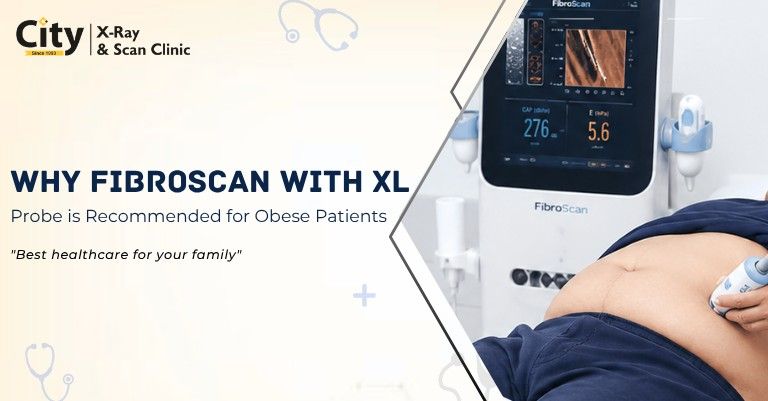
Why FibroScan with XL Probe is Recommended for Obese Patients

- Introduction
- What is Fibro Scan?
- Uses of Fibroscan
- Why did my doctor recommend FibroScan with XL?
- What preparations are required for FibroScan with XL Probe?
- What is the procedure for Fibro scan with XL Probe?
- How Fibroscan with XL Probe Works
- Who should consider getting Fibroscan with XL Probe?
- Choose City X-Ray Scan and clinic for Fibroscan with XL Probe
- Frequently Asked Questions
- Related Articles
Introduction
Excess adipose tissue in the body causes obesity, a complicated illness that can cause a number of metabolic, mechanical, and psychological issues. Over the past few decades, the prevalence of obesity has skyrocketed to an epidemic level. Fatty liver can be exacerbated or made more likely by obesity. Fatty liver in people who are either overweight or obese, have type 2 diabetes, or have a normal weight and at least two metabolic risk factors is known as metabolic dysfunction-associated fatty liver disease (MAFLD).
Liver fibrosis is the most important prognostic factor in patients with chronic liver disorders, hence it must be accurately assessed. FibroScan, a gadget designed to evaluate liver stiffness, allows for an accurate, rapid, noninvasive, and painless diagnosis of liver fibrosis. Liver stiffness measurement (LSM) using FibroScan also has the advantage of providing instantaneous data, allowing for case management decisions during the consultation and in the presence of the patient. The standard FibroScan probe has a measuring failure rate of 8% in overweight individuals (BMI ≥ 25 kg/m2) and 17% in obese patients (BMI ≥ 30 kg/m2). To address this issue, the manufacturer created the XL probe specifically for overweight/obese people.
What is Fibro Scan?
FibroScan Testing is a non-invasive diagnostic instrument that measures liver scarring or fibrosis caused by a variety of liver illnesses. Outpatient FibroScan testing, like a conventional liver ultrasound exam, is quick, painless, and simple, and it provides a non-surgical alternative to a traditional liver biopsy for assessing liver damage.
The FibroScan standard and XL probes are both used to evaluate liver stiffness, but they are tailored to distinct patient body types. The M probe is suitable for most individuals, while the XL probe is designed for overweight or obese patients (usually with a skin-to-liver capsule distance of ≥25 mm). Fibrosis is the earliest stage of liver scarring, whereas cirrhosis is more severe scarring. The FibroScan works similarly to a fibrosis scan, using scarring measurements to establish a diagnosis or follow the evolution of liver disease.
Uses of Fibroscan
Fibroscan performs several functions in liver health management, providing precise diagnostic insights without the need for intrusive procedures:
- Liver Issue Diagnosis: Identifies liver fibrosis and cirrhosis, allowing for earlier intervention and better treatment outcomes.
- Monitoring Liver Health: Analyses variations in liver stiffness over time to determine disease progression and therapy success.
- Assessing Treatment Progress: Determines how effectively therapies are functioning and recommends changes as needed.
- Liver Health Screening: This screening is ideal for people who have chronic hepatitis C or B, as it aids in the early detection and treatment of liver disorders.
- Guiding Treatment Decisions: Based on liver health assessments, clinicians can determine whether treatment or additional invasive testing is required.
- Predicting Complications: Provides insights into prospective hazards such as liver cancer, which can help guide preventive measures and ongoing treatment.
- Supports continuing research efforts to better understand and cure liver illnesses.
Why did my doctor recommend FibroScan with XL?
Your doctor probably selected FibroScan over a liver biopsy for a few reasons:
- FibroScan is significantly less intrusive, making it a more desirable alternative for both patients and physicians.
- Quick and comfortable: The process lasts less than 10 minutes and involves no recuperation time, allowing your doctor to assess your health and begin therapy as soon as possible.
- Accurate and Reliable: FibroScan gives very accurate results, allowing your doctor to diagnose liver abnormalities early and confidently monitor your status.
- Cost-effective: Your doctor recognises the limits that cost or insurance coverage can impose on your care. Fibroscan is an affordable option for you, and studies have shown it to be trustworthy and dependable.
- Early Intervention: Early identification of liver illness can result in speedier treatment and improved long-term outcomes.
What preparations are required for FibroScan with XL Probe?
- To obtain reliable liver stiffness readings, avoid eating for at least 2-3 hours before the FibroScan appointment.
- You can consume water in moderation, but avoid heavy beverages or juices prior to the test.
- Choose loose-fitting clothing to ensure easy access to the right upper abdomen.
- Continue taking regular meds.
- Most medications can be consumed as usual. Inform your doctor of any ongoing treatments.
- Avoid alcohol.
- Do not drink alcohol for at least 24 hours before the test because it can cause liver stiffness.
- Inform your doctor if you have non-alcoholic fatty liver disease, fibrosis, or viral hepatitis.
- Do not engage in strenuous physical activity right before the test, since it may influence the results.
- Stay calm and comfortable before the process to improve measurement accuracy.
- The XL probe is intended for obese people; no additional preparation is required compared to the standard FibroScan.
- Accurate readings require proper placement (laying on the back with the right arm elevated).
What is the procedure for Fibro scan with XL Probe?
- Patient Positioning: The patient is instructed to lie comfortably on their back on the examination table, with the right arm lifted above the head to expose the liver.
- Identification of the test area: The technician locates the right upper abdomen (liver region) to ensure proper probe placement.
- Application of Gel: A water-based gel is applied to the skin to provide good contact and signal transmission.
- Placement of the XL probe: The FibroScan XL Probe is gently positioned over the liver area.
- Transmission of vibrations: Transient Elastography allows the gadget to deliver painless, low-frequency vibrations into the liver.
- Measurement of liver stiffness: The gadget detects how rapidly the waves move through the liver to determine stiffness (fibrosis) and fat content.
- Multiple readings: To improve accuracy and reliability, around 10-15 reliable readings are collected.
- Real-time monitoring: The results are displayed on the screen immediately, allowing the technician to ensure accurate measurements.
- Finished the test: The complete treatment normally lasts 10-15 minutes.
- Post-procedure: The gel is removed, and the patient can immediately resume normal activities; no recuperation period is required.
How Fibroscan with XL Probe Works
Fibroscan combines elastography principles and ultrasound technology:
- Elastography Basis: Measures liver stiffness, which is an important indicator of liver health in disorders such as fibrosis and cirrhosis.
- Ultrasound waves: They are low-frequency sound waves that flow through the liver and reflect tissue stiffness without the need for ionising radiation.
- Wave Speed Analysis: Differences in wave speed imply varying tissue densities, with stiffer tissues indicating liver disease or cirrhosis.
- Stiffness Calculation: Determines liver stiffness using shear wave velocity obtained by the Fibroscan probe.
- Clinical Applications: Provides data in kilopascals (kPa), with higher values indicating greater liver stiffness, which aids with diagnosis and treatment planning.
Who should consider getting Fibroscan with XL Probe?
- People that are obese (BMI ≥ 30 kg/m2): Because the XL probe gives more accurate measurements than ordinary probes, people with more body fat gain the most from it.
- Individuals who may have fatty liver disease: For improved detection, people who are at risk of non-alcoholic fatty liver disease should use the XL probe.
- Individuals suffering from advanced fatty liver (NASH): The XL probe provides accurate liver evaluation for those suspected of having non-alcoholic steatohepatitis.
- Individuals suffering from metabolic syndrome: those who have excessive blood pressure, diabetes, obesity, and abnormal cholesterol.
- Patients with diabetes: Patients with type 2 diabetes benefit from a precise FibroScan evaluation since they are more likely to suffer liver damage.
- Patients with elevated cholesterol or triglycerides: Lipid problems raise the risk of liver fat buildup and fibrosis.
- Individuals have high liver enzymes: If liver function tests (LFTs) are abnormal, FibroScan with XL probe can aid in further investigation.
- Patients require regular liver monitoring: Those who have previously been diagnosed with liver disorders, such as Liver Fibrosis, require periodic evaluations.
- Patients whose standard FibroScan failed: If prior scans with the conventional probe proved inconclusive or failed.
- Individuals recommended by a physician: Anyone advised by a healthcare physician for a thorough liver stiffness and fat assessment.
Choose City X-Ray Scan and clinic for Fibroscan with XL Probe
- Cutting-Edge Technology: Uses modern Fibroscan technology to provide accurate liver health assessments.
- Patient-Centric Approach: Prioritises patient comfort and well-being throughout the Fibroscan procedure.
- Efficiency and Accuracy: Provides speedy results and short wait times for patient convenience.
- Affordable Pricing: We provide a FibroScan test at an affordable price
Frequently Asked Questions
What is a Fibroscan?
Fibroscan is a non-invasive diagnostic test that uses ultrasound to assess liver stiffness.
Is Fibroscan safe?
Yes, Fibroscan is deemed safe because it does not require radiation or needles.
How does Fibroscan work?
The Fibroscan transmits sound waves into the liver and evaluates their speed to determine hepatic stiffness.
Why is Fibroscan used?
Fibroscan is used to detect and monitor liver illnesses like fibrosis and cirrhosis.
Is Fibroscan painful?
No, Fibroscans are often painless. Some patients may feel moderate pain.
What conditions does Fibroscan detect?
Fibroscans can identify liver fibrosis, cirrhosis, and other liver-related disorders.
How long does a FibroScan take?
Fibroscans normally take 5-10 minutes to perform.
Is there any preparation required before a fibroscan?
Yes, fasting for at least three hours before the test is typically required.
Can Fibroscan detect liver cancer?
Fibroscan can not detect liver cancer; it only analyses liver stiffness, which is a risk factor for the disease.
Are there any negative effects from Fibroscan?
There are no known negative effects of Fibroscan.
Who can do a FibroScan?
Fibroscan tests can be performed by trained healthcare professionals, such as technicians or physicians.
Can a fibroscan replace a liver biopsy?
In some instances, yes. Fibroscan is a non-invasive method of measuring liver fibrosis.
Is Fibroscan appropriate for children?
Yes, Fibroscan is feasible for children depending on their condition and age.
Can pregnant women have a fibroscan?
It is generally not advised for pregnant women unless the advantages exceed the hazards.
How accurate is the Fibroscan in identifying liver fibrosis?
Fibroscan is highly accurate, particularly in detecting severe liver fibrosis and cirrhosis.
A high kPa score on a Fibroscan indicates what?
A high kPa score indicates increased liver stiffness, which could imply fibrosis or cirrhosis.
Can I eat before the FibroScan?
Fasting for at least 3 hours prior to a Fibroscan is typically suggested for appropriate findings.
Is a FibroScan better than a liver biopsy?
In certain circumstances, a FibroScan is less intrusive and poses less danger than a liver biopsy.
Are there any age restrictions for Fibroscan?
There are no severe age restrictions, eligibility is determined on an individual basis.
Are there any age restrictions for Fibroscan?
There are no severe age restrictions, however eligibility is determined on an individual basis.
Can Fibroscan detect fatty liver disease?
Fibroscans can detect liver stiffness associated with fatty liver disease.
What is the typical range for liver stiffness in Fibroscan results?
The usual range for hepatic stiffness is 2–7 kilopascals (kPa).
Can a fibroscan predict liver-related complications?
Fibroscan results can help determine the likelihood of problems including cirrhosis and liver cancer.
How often should Fibroscans be performed to check liver health?
The frequency of Fibroscan testing is determined by the patient's condition and the doctor's recommendations.
Can Fibroscan be used to measure treatment response in liver diseases?
Yes, Fibroscan can help determine the efficacy of liver disease therapies.
Related Articles







Comments List